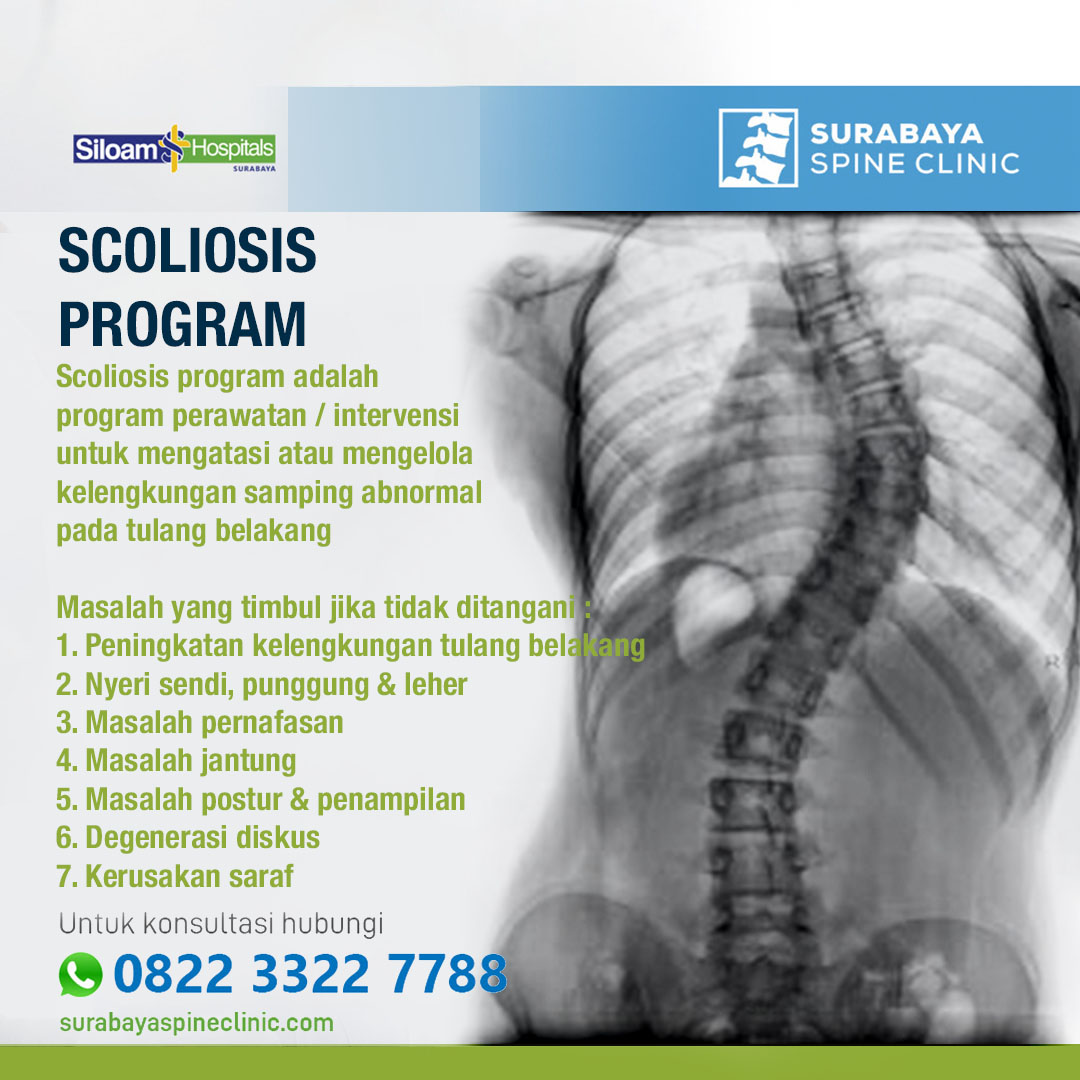
Scoliosis is a condition in which a person's spine has an abnormal side curvature. A scoliosis program is a treatment or intervention program to overcome or manage scoliosis. This program involves physical therapy, special exercises, regular monitoring, and in some cases, the use of an orthopedic corset or surgery. The goal is to prevent the curvature from increasing and reduce discomfort or other problems that may be associated with the condition.
Scoliosis is classified based on the degree of curvature, which is measured by the Cobb angle. The Cobb angle is measured using spinal radiography (X-ray). The following is a classification of scoliosis based on the degree of curvature:
1. Light: Cobb angle less than 20°. In many cases, mild scoliosis does not require special treatment other than regular monitoring to ensure the curvature does not worsen.
2. Medium: Cobb angle between 20° to 40°. For curvatures in this range, a brace or corset may be recommended, especially if the patient is still growing. The goal is to prevent the curvature from getting worse.
3. Severe: Cobb angle more than 40°. Scoliosis with this degree of curvature often requires consideration of surgical intervention, especially if there is a risk of the curvature continuing to increase or if there are other symptoms such as breathing problems or pain.
In addition, scoliosis with a curvature of more than 50° in the thoracic (upper) spine usually requires consideration of surgery due to the risk of damage to internal organs such as the heart and lungs.
Scoliosis can be diagnosed at various ages, depending on the type and cause of the curvature. Scoliosis is generally categorized by age at diagnosis:
1. Congenital Scoliosis: This is a type of scoliosis that occurs due to abnormalities present at birth. This abnormality is usually discovered when the baby is born or not long after.
2. Infantile Scoliosis: This refers to scoliosis diagnosed in children aged 0-3 years.
3. Juvenile Scoliosis: This is a scoliosis diagnosed in children aged 3-10 years.
4. Adolescent Scoliosis: This is the most common type of scoliosis and is usually diagnosed in children and adolescents aged 10 years to late in life.
5. Adult Scoliosis: Although less common, scoliosis can also be diagnosed in adults. This could be due to scoliosis not being diagnosed during adolescence or it could be due to other causes such as disc degeneration or osteoporosis.
If scoliosis is left without treatment or monitoring, some potential problems that may arise include:
1. Increased Curvature: Without intervention, spinal curvature can worsen, especially during periods of rapid growth in adolescence.
2. Pain: Over time, severe scoliosis can cause back and neck pain.
3. Respiratory Problems: Very severe curvature can affect the chest and lungs, reducing respiratory capacity and causing difficulty breathing.
4. Heart Problems: In extreme cases, space for the heart can be limited, resulting in cardiovascular problems.
5. Appearance: As curvature increases, cosmetic changes to the appearance of the back, waist, and hips may become more apparent, including unbalanced shoulders, slanted hips, or prominent ribs on one side.
6. Postural Problems: Scoliosis can affect a person's posture, which can result in imbalances and tension in certain muscles.
7. Disc Degeneration: People with scoliosis may have a higher risk for disc problems such as herniation or degeneration.
8. Joint Pain: Abnormal curvature can put more stress on the joints, especially in the lower back, which may lead to osteoarthritis later in life.
9. Nerve Damage: In very severe cases, a bent spine can press on nerves, causing pain, tingling, or weakness.
To diagnose and evaluate scoliosis, here are some diagnostic tests that are generally required:
1. Physical Examination: This is the first step. The doctor will examine the patient's back, waist and hips. They may also check whether the patient's shoulders are aligned and whether there is a difference in height between the right and left sides of the shoulder or hip.
2. X-ray (X-ray): This is the main diagnostic test for scoliosis. An x-ray will show whether there is a spinal curvature and how severe the curvature is. By measuring the angle of curvature (called the Cobb angle), the doctor can determine the severity of the scoliosis.
3. MRI (Magnetic Resonance Imaging): If there is concern about congenital abnormalities, tumors, or other causes of scoliosis, an MRI may be recommended. MRI provides a more detailed image of the spine and surrounding structures.
4. CT Scan (Computed Tomography): Like an MRI, a CT scan provides a more detailed image and can be used if further visualization of the spine is required.
5. Lung Function Tests: For severe scoliosis, lung function tests such as spirometry may be needed to evaluate how well the lungs are working, as scoliosis can affect lung capacity.
6. Neurological Examination: This may be done to assess strength, reflexes, and sensation, especially if there is concern that the scoliosis may be affecting the nerves around the spine.
In many cases, mild scoliosis may not be detected until adolescence, when rapid growth often makes the curvature more apparent. However, with regular check-ups by a pediatrician, curvature can often be detected early.
It is important to consult with a spine specialist to obtain a proper evaluation and determine which diagnostic tests are most appropriate for each individual.
Also read: D Vitamin Deficiency